%402x.svg)
A Campaign About Self-Expression and Psychological Barriers
This project was a cross-media branding campaign launched in Spring 2026 by Japanese salon booking platform Hot Pepper Beauty in collaboration with the anime Attack on Titan. The campaign aimed to reposition hairstyle changes as a positive form of self-expression rather than a risky decision.
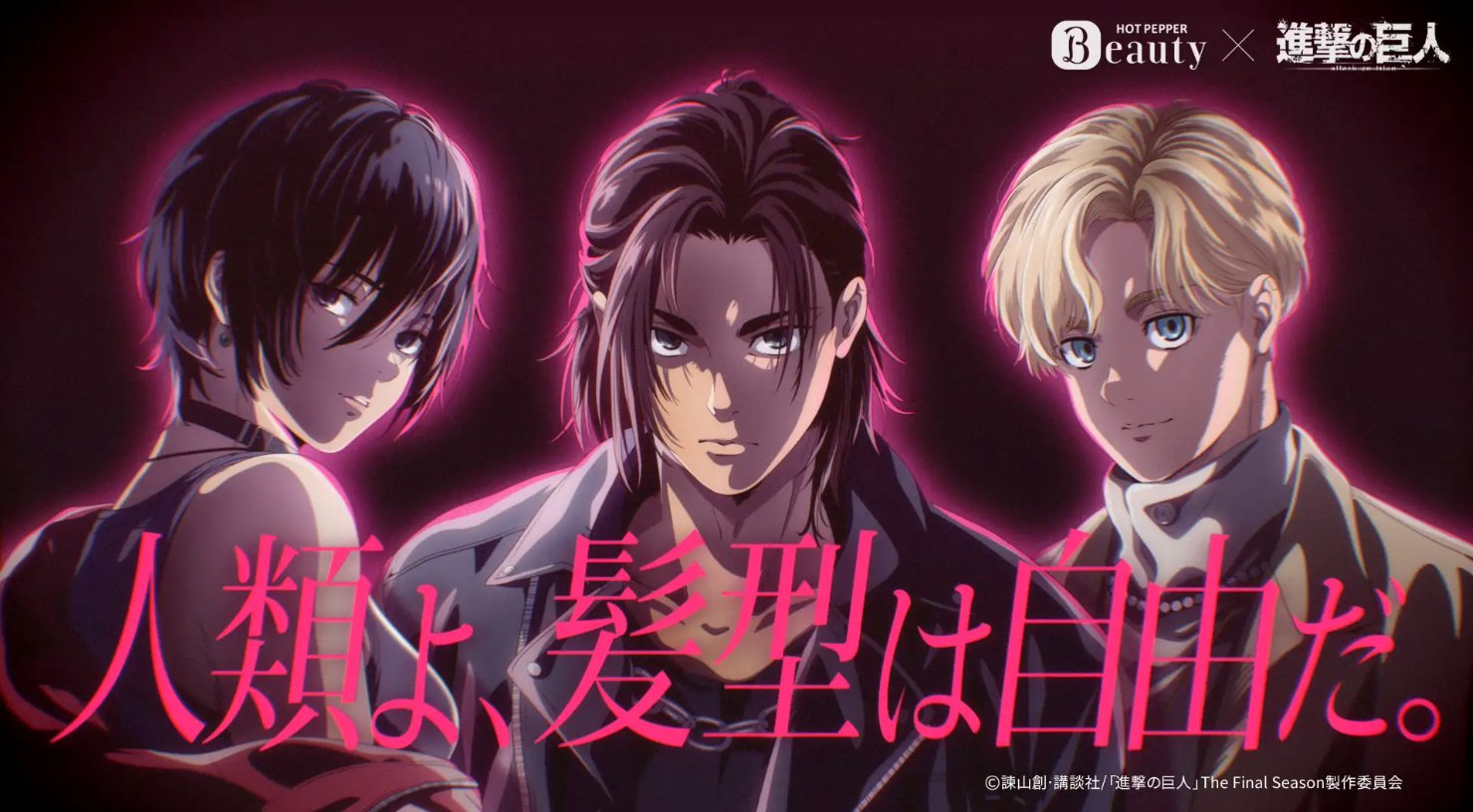
The anime’s story is set in a world where humans live trapped inside giant walls out of fear of Titans, making the "walls" a central theme. The narrative frequently addresses the inhabitants within these walls collectively as "humans" (jinrui). Cleverly mirroring this distinctive worldview, the campaign introduced the copy “Humans, Your Hairstyle is Free” (人類よ、髪型は自由だ。). This phrase serves as a direct, powerful metaphor for breaking through the psychological barriers consumers feel when trying a new hairstyle, such as the fear of failure or social judgment, which instantly resonated with fans.
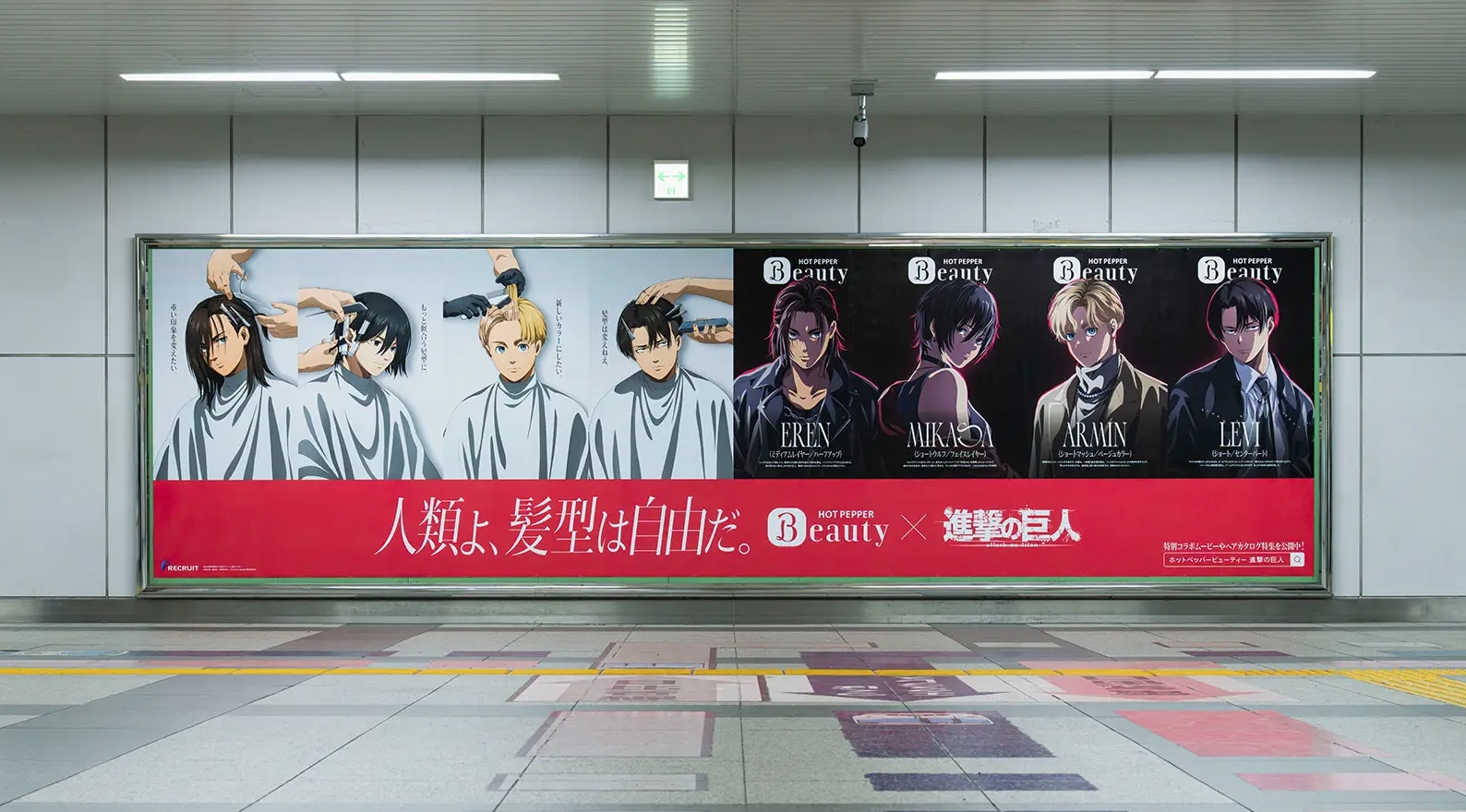
The campaign was deployed across TV commercials, social media activations (February 2026), large-scale station advertisements, and Spotify audio dramas (March 2026), creating repeated consumer touchpoints through visual storytelling and character-driven content.
Crucially, the campaign utilized completely fresh, custom artwork newly illustrated for this collaboration by MAPPA, the renowned Japanese animation studio responsible for producing the final season of Attack on Titan. In the anime community, leveraging new visuals from the official production studio - rather than recycling existing promotional imagery - elevated the campaign into a high-value special occasion for fans, driving massive organic engagement.

Featuring Familiar Anime Characters to Address Social Anxiety
One key factor behind the campaign’s resonance was its ability to translate an everyday beauty-related anxiety into a culturally familiar emotional narrative. Rather than directly promote salon appointments, the campaign focused on the emotional hesitation consumers experience before changing their appearance.
By showing well-known Attack on Titan characters overcoming their own “walls” through hairstyle changes, the campaign framed makeovers as an empowering act. The use of exclusive visuals, participatory social content, and multi-platform storytelling also helped deepen audience engagement and encouraged consumers to emotionally identify with the campaign message.
Aligning the Core Themes Between IP and Campaign
A key takeaway from this campaign is that the main campaign messaging did s not focus on the reservation service offered by Hotpepper Beauty, but the emotional and cultural connection created through the Attack on Titan IP.
Consumers were drawn to the unexpectedness of seeing familiar characters with new hairstyles and interacting with them in a completely different context. The campaign generated interest through fandom, novelty, and shareability before communicating any service-related message.
What made the collaboration effective was the strong alignment between the anime’s core themes and the campaign narrative. Attack on Titan is fundamentally a story about breaking barriers, transformation, and stepping into a new identity. By connecting these themes to hairstyle changes and self-expression, the campaign created a collaboration that felt emotionally authentic rather than purely promotional.
This highlights an important characteristic of the Japanese market: successful IP collaborations require more than simply using popular characters for visibility. Consumers respond more strongly when a brand meaningfully integrates itself into the emotional world of the IP and creates a new experience for fans. In Japan, campaigns that encourage emotional participation and cultural conversation often generate stronger engagement than direct advertising-focused communication.
"As of June 2026, specific business KPIs such as booking volume, sales impact, or conversion rates have not been officially disclosed. Therefore, the campaign’s performance cannot be quantitatively evaluated through publicly available sources alone.
However, one visible indicator of success was the strong positive reaction on social media, particularly on X (formerly Twitter), where many users organically shared favorable responses to the campaign’s visuals and concept. Much of the engagement centered around the exclusive Attack on Titan character redesigns and the novelty of seeing familiar characters in a beauty and self-expression context.
Representative positive posts on X include:
https://x.com/levinyan__/status/2031717419153317919?s=20
https://x.com/kasumi_kasa/status/2025498986346672461?s=20
https://x.com/NNL1225/status/2032102175997133046?s=20
https://x.com/BoyEggWeb3/status/2024153164858204350?s=20"